 ZIBBY
ZIBBY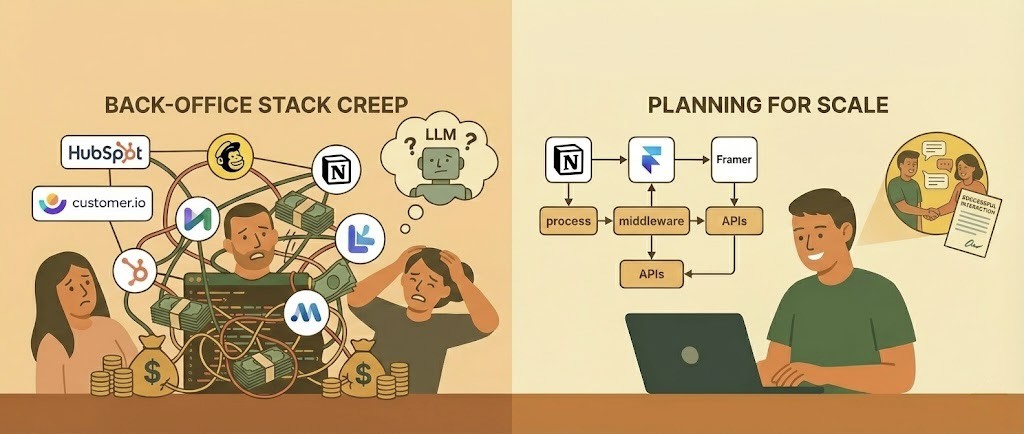
DEC 8, 2025
Software ate the World... Now its coming for your runway
### Quick Take Aways: * SaaS costs can quickly get out of hand as your bizOps Scale * RYO was rarely the right answer * Well planned RYO back-office systems built with the help of SWE/LLMs de-risks RYO ops, saves costs and enables quicker integration. “Software is eating the world.” When Marc Andreessen dropped that quote over a decade ago, it about industry disruption. He was right. Software ate retail, media, and finance. But for founders today, that quote has morphed into something darker. Software isn't just eating industries anymore—it’s eating your runway. We’ve traded the old gatekeepers for a sprawling landscape of interconnects, API keys, and subscription tiers that scale faster than your user base. As a first-time technical founder at zibby.ai, I face this dilemma daily. You’re typically left with two bad options: 1. The Monoliths: You buy into the heavyweights like HubSpot or Mailchimp. They work, sure, but you risk vendor lock-in and pricing cliffs that feel like extortion. (Go ahead, look up the price jump from HubSpot Starter to Pro. I’ll wait.) 2. The Spaghetti: You roll your own (RYO) solution. It’s flexible and cheap, but it’s risky. A failure here costs you ti
“Software is eating the world.” When Marc Andreessen dropped that quote over a decade ago, it was a prophecy about industry disruption. He was right. Software ate retail, media, and finance. But for founders today, that quote has morphed into something darker. Software isn't just eating industries anymore—it’s eating your runway.
We’ve traded the old gatekeepers for a sprawling landscape of interconnects, API keys, and subscription tiers that scale faster than your user base. As a first-time technical founder at zibby.ai, I face this dilemma daily. You’re typically left with two bad options:
1. The Monoliths: You buy into the heavyweights like HubSpot or Mailchimp. They work, sure, but you risk vendor lock-in and pricing cliffs that feel like extortion. (Go ahead, look up the price jump from HubSpot Starter to Pro. I’ll wait.)
2. The Spaghetti: You roll your own (RYO) solution. It’s flexible and cheap, but it’s risky. A failure here costs you time you don’t have, and maintaining a glasshouse construct of duct-taped microservices is a full-time job.
The "No-Code" Trap I tried to thread the needle. I avoided Mailchimp and held off on HubSpot to protect our burn rate. I went with Customer.io—a solid middle ground—but I still needed a CRM bridge to handle data ingestion, messaging, and metrics.
I started with the "least invasive" route: Make.com. I love Make; it’s a beautiful visual bridge for logic. But "least invasive" quickly turned into "most invasive." I spent a Saturday night fighting with a flow to validate Framer’s security keys. It worked, technically, but the toil was immense. I was staring at a screen full of bubbles and lines, realizing I had just built a fragile Rube Goldberg machine that I would have to babysit forever.
The Sunday Morning Experiment: Opus 4.5 Frustrated, I woke up Sunday morning with a question: Can I "vibe code" a better solution that is actually robust and in less time?
I decided to run an experiment. I wanted to replace my fragile Make.com spaghetti with a custom middleware that was performant, secure, testable, flexible, and—most importantly—leveraged Notion (a tool we already pay for) as our CRM.
I didn't just open an editor and start prompting blindly. I used Spec-Driven Development.
1. The Spec (1 Hour): I sat down and wrote a rigorous specification. I defined the inputs, the security requirements for Framer, the expected Notion schema, and the error handling. 2. The Build (30 Minutes): I fed that spec into Opus 4.5. I didn't get a prototype; I got a nearly production-ready middleware in one shot. 3. The Deploy (30 Minutes): I deployed it.
Total time: ~2 hours. That is about an hour less than it took me to get the "no-code" version barely working the night before.
Vibe Coding vs. Spec-Driven Engineering The result wasn't just fast; it was better. From that baseline, I built additional integrations to manage content, cleaned up the UI, hardened the security, and even prepared it for open-source.
But here is the critical distinction: This wasn't just "vibe coding."
There is a massive difference between "vibe coding"—where you let the LLM hallucinate a happy path until it looks like it works—and Spec-Driven Assisted Software Engineering.
If you vibe code your ops, you are building a house of cards. You cannot run operations on tools you don’t understand inside and out. But if you lead with a spec—a strict contract of what the software must do—you transform the LLM from a chaotic intern into a senior engineer who types really, really fast.
The Bottom Line Software ate the world. Now, with tools like Opus 4.5 and a spec-driven approach, software is starting to eat itself. And honestly? That might be the best thing for your bottom line.
I’m open-sourcing the middleware I built. Check it out, fork it, and stop letting subscriptions eat your lunch.