 ZIBBY
ZIBBY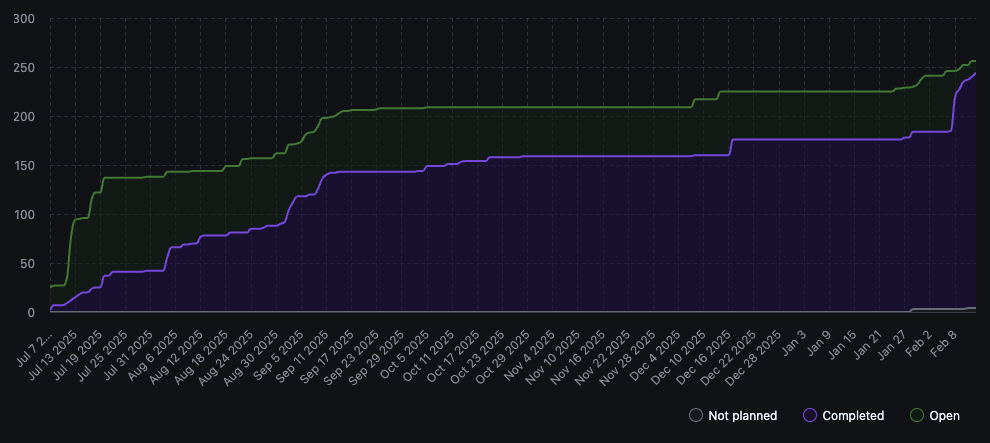
MAR 10, 2026
Flat Lining to Engineering Escape Velocity
# The Flat Line If you showed that burn up PM, they'd probably panic. A flat line in delivery velocity for months… WTF. But that flat line is the best thing that ever happened to Zibby and probably myself. ## Building Before We Knew What We Were Building Before I get into the chart, some context. My partner and I had been heads down building Zibby for a while. Between his product background and my technical background, we were iterating toward something that resembled an alpha. We had conviction in the problem space — people want to preserve their life stories, and the tools available either feel like homework or get abandoned in a drawer. We knew we were onto something. But we also knew we didn't really know what we were doing. Not in the "fake it till you make it" way. In the honest, uncomfortable way where you realize the gap between what you know and what you need to know is wider than you thought. We had ideas about hooks, engagement loops, retention mechanics — but nothing to hook them into. No validated user. No refined problem statement. Just energy and code. We solicited a ton of feedback and it helped but we knew it didn’t have the shape of a company. We needed some
# The Flat Line If you showed that burn up PM, they'd probably panic. A flat line in delivery velocity for months… WTF. But that flat line is the best thing that ever happened to Zibby and probably myself. ## Building Before We Knew What We Were Building Before I get into the chart, some context. My partner and I had been heads down building Zibby for a while. Between his product background and my technical background, we were iterating toward something that resembled an alpha. We had conviction in the problem space — people want to preserve their life stories, and the tools available either feel like homework or get abandoned in a drawer. We knew we were onto something. But we also knew we didn't really know what we were doing. Not in the "fake it till you make it" way. In the honest, uncomfortable way where you realize the gap between what you know and what you need to know is wider than you thought. We had ideas about hooks, engagement loops, retention mechanics — but nothing to hook them into. No validated user. No refined problem statement. Just energy and code. We solicited a ton of feedback and it helped but we knew it didn’t have the shape of a company. We needed something more structural. So we joined Fi.co and got to building the REAL ZIBBY ## The Flat Line That's where the plateau comes in. During my time at the Founder Institute, I pulled back from engineering almost entirely. Truth be told, I thought that was going to be brutal. I'm a builder. Sitting in the problem space instead of the solution space felt like being asked to stop breathing and whats more is that I respected the problem that I knew deep down the only way to truly do that was to stop coding and start listening and being as curious and open as possible. I expected the skepticism about the space. Legacy preservation and family storytelling isn't exactly a space known for breakout successes — it's more of a graveyard than a garden. I was ready for every "why this, why now" question. What I wasn't ready for — what nobody warned me about — was how important it would be to laser focus on one problem and one highly defined target user. Not two problems. Not a broad demographic. One and one. And honestly? I wound up loving it. I couldn't get enough of talking to users. Not just because it made me a better founder or because it gave the product and business clearer direction — though it did both. It was because every conversation turned into a Zibby experience in itself. I'd sit down with someone to ask about their relationship with family stories, and 20 minutes later they're telling me about their grandmother's immigration story or the recipe their dad never wrote down. The users were validating the product by living it in the interview. That hit different. But on the chart? Flat. Months of it. And that was exactly right. ## The Hockey Stick Then look at what happens at the end. I impressed even myself. I graduated from Fi.co on February 4th. By the following week, we were mostly feature-locked. Here's what happened. Stepping back from Zibby's product engineering for those months gave me space to fundamentally rethink my development workflow. I didn't just come back to coding — I came back with a completely different system. A few specific things unlocked a tremendous amount of velocity with high code quality. I went vanilla and got deliberate. First thing I did was kill everything. All the MCPs, Skills, Agents — gone. I started with raw Claude Code and just coded. Then I was very intentional about what I brought back and how. Using Docker MCP tooling for on-demand loading gave me much better context management. Every skill and agent was examined for relevance and use case fit. More often than not, they got rewritten with SwiftUI, C++, and GCP specifics baked in, plus references to our own knowledge base. The generic stuff was creating more noise than signal. I built a real design system. That bump you see around December? That's me building a tokenized design system. This was a massive unlock in refinement. Simplifying not just where tokens live but how many there are gave us a huge boost in premium look and feel. And the downstream impact on AI-assisted development was just as significant — better first shots, better plans, fewer iterations to get something that actually looks right. I chose and built on an agentic system. This is where it all came together. The two biggest impacts were dramatically better planning and much better context management through multi-agent orchestration. My flow became a single pipeline that combines PRD-Taskmaster for AI-generated product requirements, Agent OS for coding standards and spec shaping, Codex as an antagonistic reviewer, and GitHub Issues as the PRD and planning artifacts. I also built a triage skill to enhance all of this — both in research and in kicking off orchestration — but that's a whole other post. The key insight is that these flows require thoughtful prompting and interaction. There are things the system can provide in terms of context and analysis, but the surrounding tools aren't built for it. So this workflow let me brain dump a bunch of things and I'd either get a fully fledged workflow ready to kick off or shell GitHub Issues with research and context for me to pick up when I was ready. The result is that chart. Months of foundation, then a near-vertical delivery curve. ## What's Next There's still a lot to do, but as I shift into beta and GA mode, most of the remaining items will probably be weekend projects. There's a huge opportunity for self-improvement and learning in this workflow, and always more autonomy to unlock. But the bigger point is this: I'm building Zibby to preserve humanity's life stories. The tooling and the velocity matter because the mission matters. Every week I'm not shipping is a week someone's story goes untold. Time to get it into the hands of some humans.